
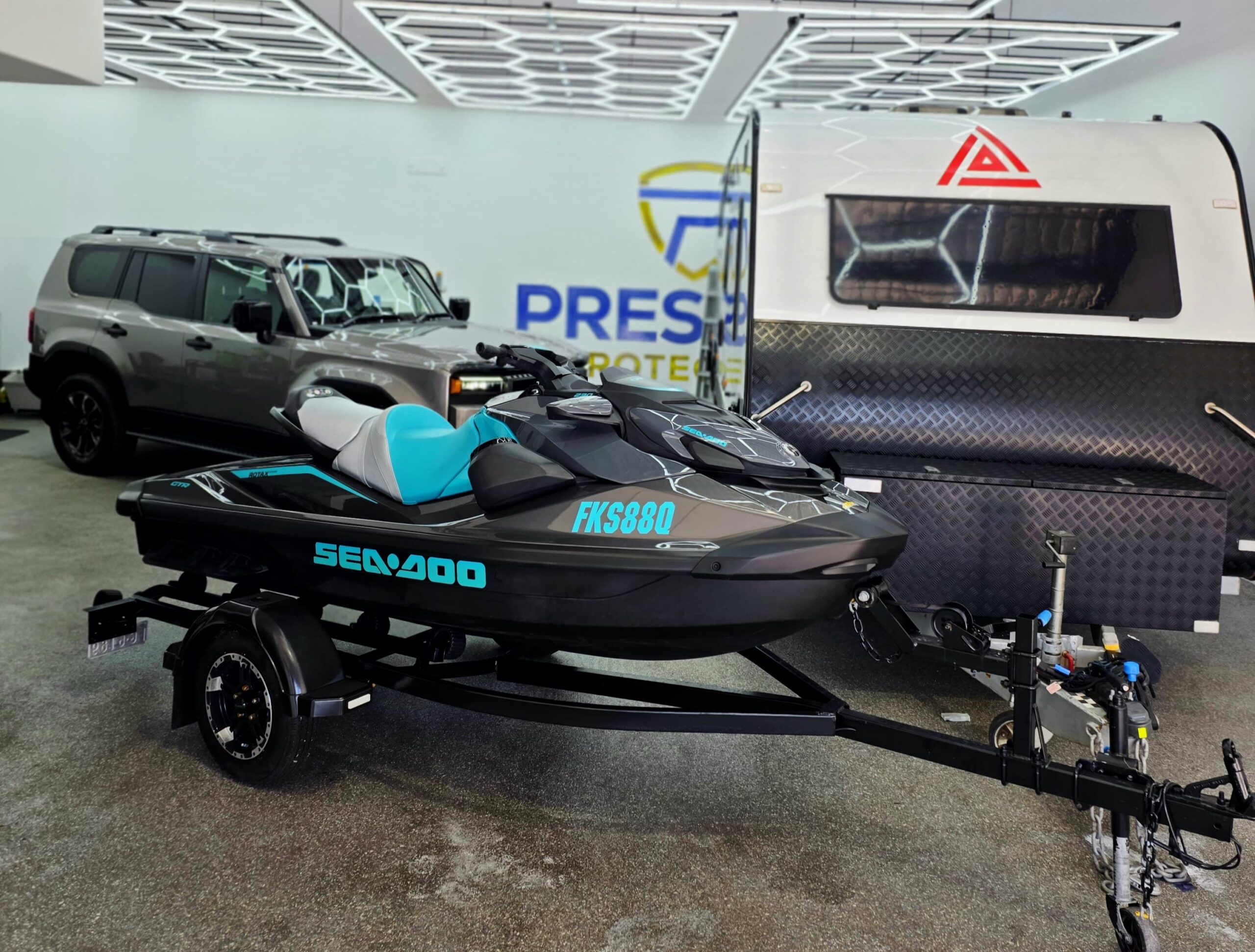
A jet ski lives harder than almost anything else we coat. It is launched and retrieved constantly, it sits on a trailer in full sun between rides, it gets salt on every surface and then dries in the open, and the parts you grab and stand on are the same parts taking UV all day. Everything that dulls a boat happens to a ski faster, on a smaller surface, with more handling.
A ceramic coating does the same job here as on a hull. It takes the UV and salt instead of the gelcoat, and it makes the rinse-down after a ride do most of the cleaning for you, which matters when the alternative is scrubbing a surface that is already going chalky.
Surface area is the reason, oddly enough. A ski has very little of it, and almost all of it is exposed. There is no cabin, no shade, no topsides that sit in shadow, and the deck is angled to catch sun most of the day. It also spends far more of its life out of the water and on a trailer than a moored boat does, so the UV exposure per hour of use is much higher.
Then there is the handling. People stand on skis, kneel on them, drag gear across them and haul themselves back on from the water. Those contact points wear through protection faster than anything on a boat except the swim platform.
Most of the damage we see on older skis is not from the water. It is from loading, unloading and travelling: rub marks where the hull sits on the bunks, scuffing at the bow eye, and chips along the lower edges from grit thrown up on the way to the ramp.
A coating does not stop that. It is chemical and UV protection, not impact protection, in exactly the way we explain for cars in coating versus film. What helps trailer rash is bunk carpet in good condition, correct bunk alignment so the hull sits where it should, and taking thirty seconds to check the ski is sitting square before you drive off.
| What it helps with | How much difference it makes |
|---|---|
| Salt haze and white film after rides | Large. Salt sits on the coating and rinses rather than keying into porous gelcoat |
| UV fade on deck and hull | Large. This is the main cause of a ski looking old before it is |
| Grey chalky film on older skis | Slows its return considerably once the surface has been cut back first |
| Water spotting from drying in the sun | Noticeable, since water beads and runs rather than pooling |
| Trailer rash and bunk rub | None. This is contact damage and needs the trailer sorted instead |
| Deep scratches and impact chips | None. Same limit as any coating |
If the ski has gone grey and chalky, the coating goes over the top of that unless the oxidation comes off first. Ceramic coatings are clear and fill nothing, so whatever is on the surface when it cures stays visible for the life of the coating. On a ski that has spent five summers on an open trailer, expect a cut and polish before anything else happens.
That is the same principle covered in why boats go chalky and how much comes back, and it applies to skis with one extra caution: the gelcoat on a ski is generally thinner than on a hull, so there is less to work with and less room for repeated heavy cutting.
Rinse with fresh water after every single ride, before the salt dries. That one habit does more than any product. Get the flush done properly at the same time, then dry the deck rather than letting it evaporate in the sun and leave mineral spotting.
Cover it or shade it on the trailer. A ski parked uncovered in a Queensland driveway is taking the worst of both worlds, full sun and dried salt, on a surface with nowhere to hide. If you want a number for yours, bring it in and we will look at the condition before quoting.
It is arguably better value than on a car, because a ski dulls faster and there is far less surface area to treat. The main gain is the rinse-down after every ride becoming trivial rather than a chore, which is what keeps a ski looking good over years.
No. Bunk rub, bow eye scuffing and chips from grit are contact damage. A coating is UV and chemical protection. The fix for trailer rash is bunk carpet in good condition and correct alignment, not a product on the hull.
Usually yes, by cutting the oxidised layer back to sound gelcoat first. The caveat on skis is that gelcoat tends to be thinner than on a boat hull, so there is less material to work with if it has been cut hard before.
Less than the same coating on a car, and it depends heavily on use. Constant immersion, handling, and full sun on a trailer all wear it faster than a garaged vehicle. Rinsing after every ride and keeping it covered extends it considerably.
Ceramic coating is a topsides product. For a ski that is trailered and not left moored, that covers essentially the whole thing. If a ski is kept in the water permanently, growth becomes a different problem that a coating does not address.
Quoted per ski, because condition drives the labour. A near new ski needs a light polish and a coating. One that has spent years uncovered needs cutting back first, and that is where the time goes.
At Prestige Protection we offer superior product and premium service for all car protection services. Save up to 50% off dealership prices when you choose us.