
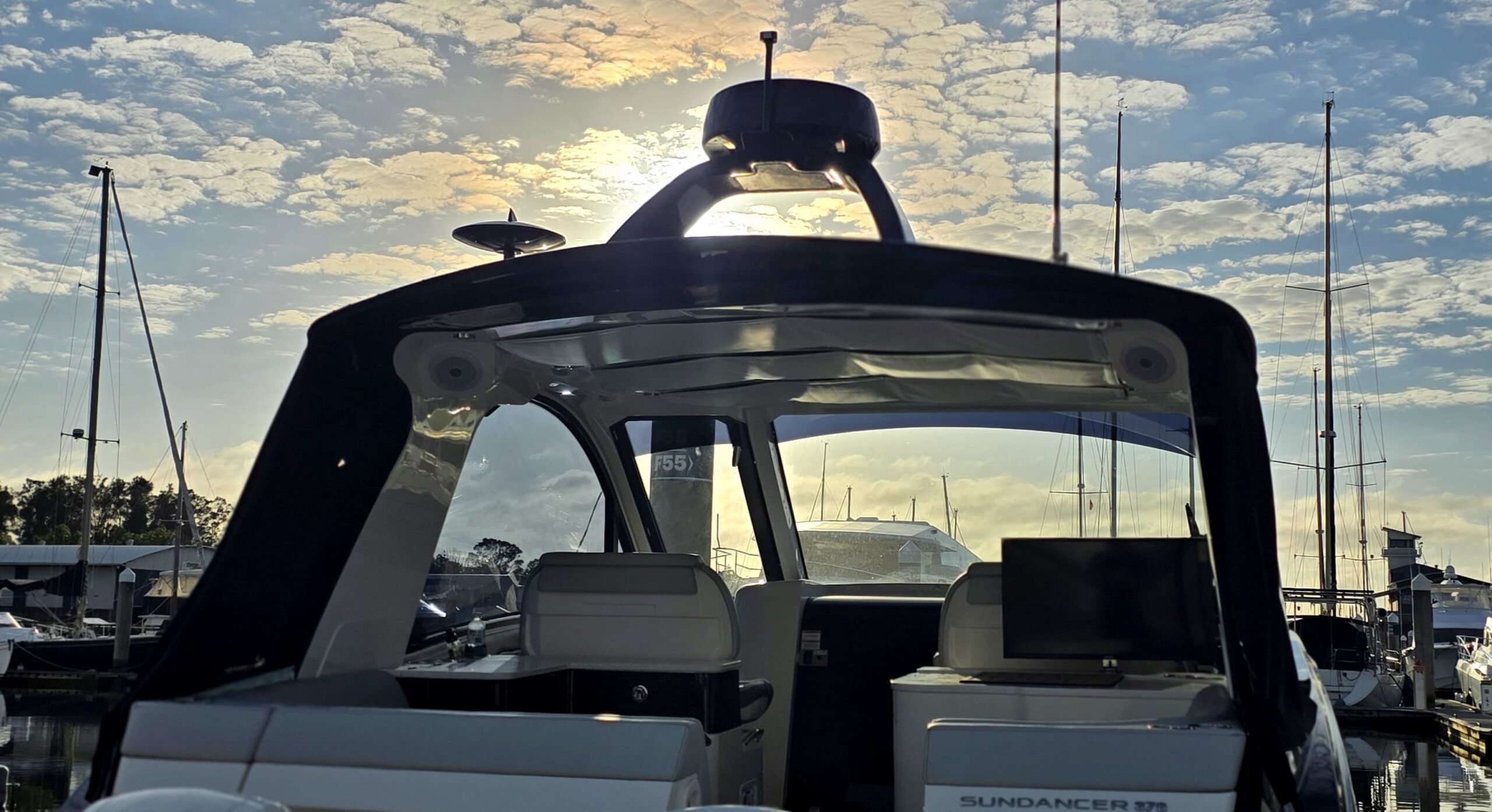
Boat window tinting solves a problem most owners underestimate. A boat cabin in a Queensland summer is a greenhouse. Glass on all sides, no shade, and sun coming from above and again off the water, which is the part people underestimate. Water reflects a serious amount of UV and light straight back up through your side glass and windscreen, so a cabin takes it from two directions where a car takes it from one.
Window film does the same job here as in a vehicle. It cuts the infrared that carries most of the heat you feel, blocks UV that fades upholstery and dash surfaces, and reduces the glare that makes a long run into the sun exhausting. What changes is the glass, the rules and the priorities.
The single most useful thing to understand is that how dark a film looks and how much heat it stops are two different measurements. Visible light transmission describes shade. Infrared rejection and total solar energy rejected describe heat. Most of the heat you feel is infrared and invisible, which is why a light ceramic film can outperform a much darker cheap one.
On a boat that matters more than it does on a car, because visibility is safety. You do not want a dark cabin when you are watching for markers, other vessels or a shallow patch at dusk. Ceramic films let you take the heat out without taking the visibility with it, which is the same argument we make in does darker tint mean better heat rejection.
The strict visible light transmission limits in Queensland window tint law exist for road vehicles and driver visibility. They are written for cars, not vessels. That does not mean anything goes, since you still need to see properly to operate safely, and a helm position with poor visibility is a genuine hazard rather than a legal technicality.
In practice we treat helm glass conservatively and give cabin and accommodation glass more latitude, because the risks are different. Tell us the vessel and how you use it and we will work through what makes sense before anything is fitted.
| What differs | Why it matters |
|---|---|
| Curved and compound-curved panes | Needs shrinking and forming rather than a flat cut |
| Acrylic and polycarbonate windows | Very different from tempered glass and easily damaged by the wrong products |
| Larger single panes | Harder to fit cleanly, less forgiving of contamination |
| Constant salt on both sides | Preparation has to be thorough or the film will not bond properly |
| Frames and rubbers that hold water | Edges need care so moisture does not sit against the film |
Acrylic in particular deserves a warning. It is soft, it scratches easily, it is sensitive to solvents, and it is common on smaller boats. Treating acrylic like automotive glass is how you turn a tinting job into a window replacement, which is one of several reasons this is not a driveway job.
Film traps whatever is in the air between itself and the glass, permanently. Wind, pollen and dust on an open hardstand are the enemy of a clean install, and a boat has larger panes than a car, which means more area for something to land on. Working in a controlled space is the difference between a finish you never think about and one speck you notice every trip.
That is the same argument set out in studio versus mobile, and it applies harder to large marine panes than to car windows.
Cabin temperature on a hot day at anchor is the obvious one. The less obvious ones are that the upholstery, dash plastics and timber stop fading, that glare at dawn and dusk drops enough to make a long run more comfortable, and that condensation and salt film are easier to clean off a filmed surface than bare glass.
Every film we fit carries a lifetime warranty against bubbling, peeling and fading. If you want to talk through what suits your boat, get in touch and tell us the vessel, or have a look at the film range on our window tinting page.
Those limits are written for road vehicles and driver visibility. Vessels are a different context, but visibility at the helm still matters for safe operation, so we treat helm glass conservatively and give cabin glass more room. Tell us the boat and we will confirm before fitting.
Often, but it needs the right approach. Acrylic is soft, scratches easily and reacts badly to some solvents, so it is not a case of using car products on a different shape. We assess the material first, because getting this wrong costs a window rather than a film.
It slows it considerably, which is the realistic claim. UV is what breaks down fabric, vinyl and timber finishes, and film blocks the overwhelming majority of it. Nothing stops fade entirely on a boat that lives outdoors, but the difference over years is substantial.
There is less to do, but helm screens, clears and any enclosed space still benefit, mostly for glare and UV rather than cabin temperature. It is worth a conversation rather than an assumption either way.
Leave them alone while the adhesive cures, and we will tell you how long for your boat and the conditions. After that, avoid ammonia based cleaners permanently, since ammonia attacks both the adhesive and the film.
It usually is, since the boat is already with us and both jobs are quoted per vessel. Combining work is also where we can discount a package rather than charging two separate visits.
At Prestige Protection we offer superior product and premium service for all car protection services. Save up to 50% off dealership prices when you choose us.