
A paint protection package is worth the money when someone spends real time preparing the paint before anything goes on it, and it is close to worthless when they do not. On the Gold Coast you will be quoted anywhere from $40 for a DIY spray kit to $3,000 or more for a full studio package, and almost all of that gap is preparation and labour rather than the liquid in the bottle.
In round numbers: DIY kits run $40 to $150 and last three to six months. Dealership add-ons run $800 to $1,500 and are usually applied in under an hour with no correction. Professional coatings here start at $995 for XPEL Fusion Plus V2 with an 8 year warranty, $1,395 for Kovalent Borophene with a 9 year warranty, and $1,795 for Kraken Graphene Titanium with a 10 year warranty. Paint correction, where the paint needs it, is quoted separately from $100 for the first hour. What follows is what actually separates those tiers, including the one hardness claim the whole industry quotes and almost nobody explains properly.
The term covers any bundle of treatments sold to preserve a vehicle exterior. At minimum it means a sealant or ceramic coating on the painted panels. Bigger packages add coatings for glass, wheels and exterior trim, and often an interior treatment for leather, vinyl and fabric. Some businesses also offer paint protection film across the high impact areas at the front of the car, which is a separate product from a coating.
The job of all of it is the same: put a sacrificial layer between your clear coat and everything the road throws at it, so that UV, bird droppings, bug splatter, tree sap, salt and road grime hit the layer instead of the paint. A good one also makes the car much easier to wash, which matters more than most people expect, because most swirl marks are put there by washing rather than by driving.
Every quote you will get on the Gold Coast falls into one of five brackets. Seeing them side by side makes the value question a lot easier to answer.
| Option | Typical price | Typical lifespan | Paint correction included | Best suited to |
|---|---|---|---|---|
| DIY spray kit | $40 to $150 | 3 to 6 months | No | Owners who enjoy re-applying often |
| Dealership add-on | $800 to $1,500 | Months, not years | No | Very few buyers |
| XPEL Fusion Plus V2 | $995 | 8 year warranty | Quoted separately from $100 per hour | Proven protection at a sensible price |
| Kovalent Borophene | $1,395 | 9 year warranty | Quoted separately from $100 per hour | Harder, glossier finish, better water repulsion |
| Kraken Graphene Titanium | $1,795 | 10 year warranty | Quoted separately from $100 per hour | Self healing, the top of the range |
Those lifespans are typical ranges rather than guarantees. They assume the car is washed properly and topped up occasionally, and they move depending on the product used, how much prep went in underneath, and whether the car lives in a garage or under a gum tree. Price also moves with vehicle size and paint condition, which is why a genuine quote follows an inspection rather than a phone call.
Most DIY products sold as ceramic coatings are spray sealants with a small amount of silicon dioxide in them. They go on in an hour or two over a basic wash, they bead water nicely for a few weeks, and they add a little gloss. None of that is fake. The problem is durability: without machine polishing and a proper panel wipe underneath, the product is bonding to whatever is already sitting on your clear coat, and under Queensland sun and salt air it gives up in three to six months.
That makes DIY a reasonable choice for someone who enjoys the ritual and re-applies every season. It is a poor choice for anyone buying protection so they can stop thinking about it. We have broken the comparison down further in our guide to DIY ceramic coating versus professional application.
Paint protection sold at the point of sale is a high margin add-on, and it is priced as one. The pattern is consistent: an application taking under an hour, no correction beforehand, a basic polymer sealant or low grade ceramic, applied by whoever is free rather than by a coating technician, at $800 to $1,500 for a product that often costs the dealership a fraction of that.
The lifetime warranty language attached to these deals is where people get caught. Read the conditions and you will usually find scheduled inspections, approved products, and exclusions broad enough to cover most of what you would want to claim for. The result is a car that is not really protected and an owner who believes it is, which is worse than no coating at all. We have written up how these offers are structured in our piece on dealership ceramic coating and window tint packages.
Nearly every coating on the market is advertised as 9H, and nearly every buyer reads that as a score out of ten on the Mohs mineral scale, where nine is sapphire and ten is diamond. It is not. The 9H figure comes from the pencil hardness test, standardised as ISO 15184, Paints and varnishes: determination of film hardness by pencil test, in which graded graphite pencils are pushed across a cured film to see which one marks it. Graphite pencils range from 9B at the soft end to 9H at the hard end, and 9H is simply the hardest pencil in the set.
So a 9H rating means the coating resisted the hardest pencil in a standard test. It does not mean your paint is now scratch proof, rock chip proof or anywhere near sapphire. In practice a quality coating gives you a dense sacrificial layer that resists wash-induced swirl marks, micro-marring and chemical etching from bird droppings and bug splatter. It will not stop a key, a shopping trolley or a stone off a truck. Ratings above 9H, such as the 9H+ and 10H figures quoted on premium coatings, are the manufacturers own rather than part of the standard, so read them as product tiers rather than physics. A Mohs figure is a different matter, because that scale measures minerals and has nothing to do with coatings at all.
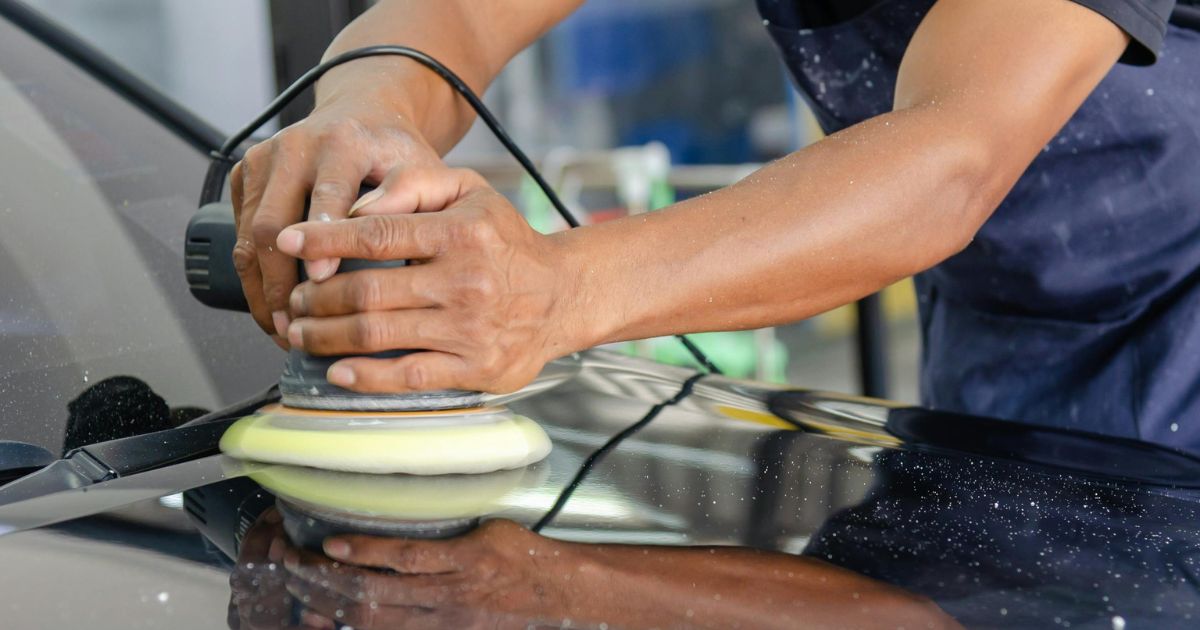
This is the part that justifies the price difference. A professional package is mostly preparation, and the coating itself is the last and quickest step. Done properly it runs through decontamination to strip embedded iron and bonded contaminants, clay barring to leave the surface genuinely clean, stage 1 or stage 2 machine correction to remove swirls, oxidation and light scratches, and a panel wipe so nothing interferes with the bond. Only then does the coating go on, followed by a cure of 24 to 48 hours or an accelerated cure under infrared lamps.
Skip the correction and you seal the defects in. Every swirl mark and every bit of oxidation is locked under the coating for as long as the coating lasts, and the only way out is to remove the coating and start again. That is the single most expensive mistake in this category, and it is why we treat paint correction before ceramic coating as part of the job rather than an upsell. It is also why environment matters: controlled lighting and a dust-free space change what is possible, which we cover in studio versus mobile paint protection.
Stone chips. It is worth being blunt about this, because it is the expectation most often oversold at the point of purchase. Chips are impact damage, and the only thing that absorbs impact is paint protection film, a thick urethane layer applied over the panel. Film is a separate specialty with its own equipment and its own skill set, and it is not something we offer. If chips on the bonnet and bumper are your main concern, a dedicated film installer is who you want, and there is no coating at any price that substitutes for it.
What we do is the coating side of the equation, along with window tinting, interior protection and BlackVue dash cam installation. Between them those cover UV, chemical etching, wash damage, heat load through the glass and interior fade, which is the great majority of what actually degrades a car on the Gold Coast. Impact damage is the exception, and we would rather tell you that than sell you a coating on a promise it cannot keep.
A new car is the cheapest car to protect, because the paint is already close to its best and there is little correction to pay for. You are locking in the finish rather than rebuilding it, and you avoid the slow decline that starts the first time the car sits in a car park in February. If you are collecting a car soon, the sequence matters, and we have set it out in what to do first with a new car.
Used cars are still worth doing, but the quote will carry more correction. Older paint tends to have swirl marks, oxidation, light scratches and water spotting, and all of that has to come out before anything is sealed over it. The upside is that the visual change is far bigger on a tired car than on a new one. A dull ten year old finish that has been corrected and coated looks like a different vehicle, and it stays that way.
UV is the main one. Queensland Health advises that the state records a UV index of 3 or above all year round, including through winter. That is a guideline written for skin, but the same radiation is working on your clear coat every day of the year, and it is the reason reds and blacks fade here faster than they do further south.
Then there is the coastal load. Salt carried in the air settles on every horizontal surface and works at untreated metal and trim. Humidity keeps moisture sitting on the paint for longer, which speeds up oxidation and gives mould a chance on interior fabrics. Sudden downpours leave mineral deposits that etch if they dry in the sun. Add bird droppings and eucalyptus sap from bushland parking and the case for a sacrificial layer is stronger here than almost anywhere else in the country. It is also why interior treatment is not an afterthought in this climate, and why we run car interior protection as its own service.
A coating reduces washing, it does not remove it. Dirt still lands on the car, it just does not bond as hard, so a rinse and a pH-neutral wash every two to four weeks does the job that used to take a bucket of effort. Dry with a microfibre towel or a blower rather than letting it air dry, keep away from automatic washes with spinning brushes, and top up with a ceramic spray every six to twelve months.
Aftercare is where most of the difference between a two year result and a five year result comes from. Coatings do not fail on their own nearly as often as they get scrubbed off by bad washing technique.
The honest verdict comes down to which version you are buying. A DIY spray at $40 to $150 is worth it only if you enjoy re-doing it two or three times a year. A dealership add-on at $800 to $1,500 with no correction is the one to walk away from, because you are paying professional money for an amateur result and a warranty that is hard to claim on. A properly prepared coating from $995 upwards is worth it, and the more correction it includes the better the value looks over the years you own the car. Expect the coating to carry an 8, 9 or 10 year warranty depending on which of the three you choose, expect film rather than coating to be what stops stone chips, and expect any quote that skips the prep conversation to be selling you the cheap version at the good version price. If you want a number for your own car, our ceramic coating service on the Gold Coast starts with an inspection of the paint you actually have, and you can book that in here.
The three coatings we fit carry 8, 9 and 10 year warranties. How long one performs at its best depends on the preparation underneath and how the car is washed afterwards. Entry-level coatings sit at the shorter end and full studio packages at the longer end. Any figure quoted to you assumes proper aftercare, so treat a long number attached to no maintenance advice with suspicion.
Rarely at the price charged. The issue is not that dealerships cannot sell a good product, it is that the application is fast, uncorrected, and usually done by general staff rather than a coating technician. If you are offered one, ask what correction is included, who applies it, how long the car is off the lot for, and what voids the warranty. The answers usually settle it.
No. A coating is measured in microns and resists chemical and light physical damage such as swirl marks and etching. Stone chips are impact damage, and the only thing that reliably absorbs them is paint protection film across the front of the car. Anyone telling you a 9H coating stops chips is misreading a pencil hardness rating.
Yes, and it is often where the biggest visual improvement happens. The condition of the paint decides how much correction is needed, which is the main variable in the quote. Badly oxidised or previously repainted panels need assessing in person, because there are cases where correction is limited by how much clear coat is left to work with.
Correction is charged separately from the coating, starting at $100 for the first hour, and it scales with vehicle size and paint condition. The coating price itself is set by which of the three products you choose. It is also the part of the job you should never remove to save money, because a coating applied over defects locks them in for the life of the coating.
Yes, but it is faster and gentler. A wash every two to four weeks with pH-neutral soap and a soft mitt, dried with microfibre or a blower, keeps the coating performing. Skip the automatic washes with brushes, since those put in the swirl marks the coating is there to prevent.
At Prestige Protection we offer superior product and premium service for all car protection services. Save up to 50% off dealership prices when you choose us.