
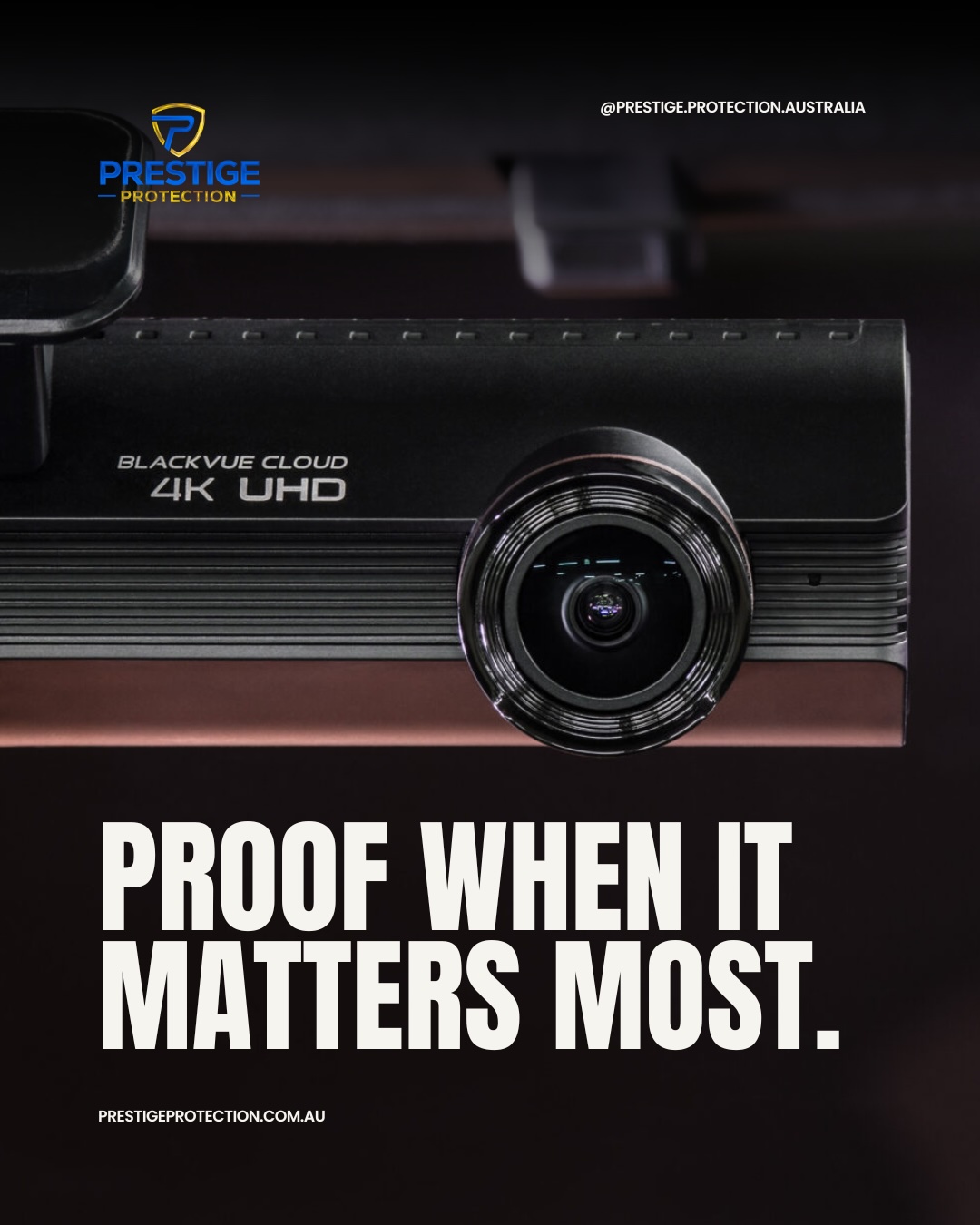
Three decisions, in this order of importance: front and rear or front only, 4K or 2K, and how big a card to put in it. Front and rear matters most, because a forward camera cannot see the thing that hits you from behind. Resolution matters second, and only really at night. Card size matters least until the day you need footage from four days ago and find it has already been overwritten.
Our range covers all three: Elite 10 Front and Rear at $1,345 installed, Elite 8 Front and Rear at $1,045, and front only from $945, all with a 3 year warranty and a 64GB card included.
A forward facing camera records what you drive into. It does not record the car that runs into the back of you at a set of lights, the one that clips you while overtaking, or whatever happens behind you in a car park while you are at work. Rear impacts are a large share of the incidents where fault gets argued about, and they are precisely the ones a front only camera misses entirely.
If the budget only stretches to front only, it is still far better than nothing and it still covers the most common serious incident. But if you are choosing between spending more on resolution or spending it on a second camera, the second camera wins.
In good daylight, 2K is genuinely fine. You will read plates, see lane positions and establish what happened without difficulty. The difference shows up when the light drops: early morning, dusk, and at night on the M1, where a plate that is a readable set of characters on a 4K sensor becomes an unreadable blur on 2K.
That is the whole distinction between the Elite 10 and the Elite 8. If most of your driving is daytime and suburban, the Elite 8 at $1,045 for front and rear is a sensible buy. If you commute in the dark, tow at night, or simply want the plate legible in the worst conditions rather than the best, the 4K front on the Elite 10 is what you are paying the extra $300 for.
| Card | Roughly how much footage | Best for |
|---|---|---|
| 64GB, included | 1 to 2 days | Drivers who check footage immediately or not at all |
| 256GB, $189 | 4 to 6 days | Most people, and the upgrade we recommend most often |
| 512GB, $319 | Longest window before it loops | High kilometres, rideshare, or long parking mode use |
Every dash cam loops, meaning it records over the oldest footage once the card is full. That is normal and it is how they are designed to work. The catch is that damage is not always noticed the same day. If you find a dent on Thursday that happened on Sunday, a 64GB card has almost certainly recorded over the evidence, while a 256GB one probably has not.
That is the real argument for the upgrade, and it is worth more than most people expect for $189. It is the difference between having a week to notice something and having a day.
If you run parking mode, the camera is recording while the car is parked as well as while you drive, which uses card space faster. Motion and impact triggered modes are far more economical than continuous recording, but either way a larger card buys you a longer window before the loop catches up.
How parking mode affects your battery, and how it should be configured, is covered in does a dash cam drain your battery.
For most Gold Coast drivers, Elite 10 front and rear with a 256GB card. Front and rear because rear incidents are the ones you cannot otherwise prove, 4K because a lot of driving here happens at either end of the day, and 256GB because a week of footage is genuinely useful where a day often is not.
If that is more than you want to spend, Elite 8 front and rear at $1,045 with the same 256GB upgrade is the better compromise than going to 4K front only, because coverage beats resolution. Everything is hardwired, with no suction cups and no visible cables. Options are on our dash cam installation page and you can book in here.
It depends when you drive. In daylight 2K is genuinely fine. The difference appears in low light, where 4K keeps a number plate readable that 2K blurs. If you regularly drive at dawn, dusk or at night, that is what the extra $300 buys.
Front and rear, if you can. A forward camera cannot record the vehicle that hits you from behind or clips you in a car park, and those are exactly the incidents where fault gets disputed. Coverage is a better use of money than resolution.
Roughly one to two days before it loops over the oldest footage. That is fine if you check straight away, and not fine if you notice damage days later. A 256GB card at $189 gives you around four to six days, which is why we recommend it most often.
It loops, recording over the oldest footage first. That is by design. Locked or emergency files are protected from being overwritten, which is why locking the file after an incident matters.
Memory cards wear out with constant rewriting, which a dash cam does continuously. Treat the card as a consumable, check the footage occasionally to confirm it is still recording properly, and replace it rather than waiting for it to fail silently.
Yes, though it is easier to do at the time of fitting. Add the size to your booking and we will fit it on the day rather than you needing to come back.
At Prestige Protection we offer superior product and premium service for all car protection services. Save up to 50% off dealership prices when you choose us.